

A common complaint from beginners practicing the method of loci is retrieval latency. When asked a direct question during a technical interview or high-stakes presentation, having to walk through eight intermediate rooms just to reach station thirty-two feels agonizingly slow. If your recall requires thirty seconds of mental walking, the palace remains a theoretical novelty rather than an agile professional tool. Maximizing memory palace retrieval speed requires transitioning from sequential crawling to non-linear random access.
Your brain does not need to walk every step of a hallway to recall what sits on a specific shelf. By installing architectural indexing waypoints and running high-velocity mental sprint drills, you train your mind to jump directly to any coordinate instantly. At EZ Upskill, we break down high-level cognitive techniques into measurable micro-skills, helping learners operate with rapid fluency under real-world pressure.
Key Takeaways
Proven methods for accelerating mental retrieval speed across your palaces:
- Transition from linear sequential scanning to random-access retrieval by tagging landmark waypoints every five stations.
- Condition your mental navigation using timed sprint drills, reverse traversals, and odd-even alternating sweeps.
- Streamline cognitive rendering: visualize only the focal mnemonic interaction rather than rendering the entire room in photo-detail.
- Simulate high-pressure environments to build retrieval resilience under stress, time limits, and external noise.
- Combine speed drills with deliberate micro-skills practice to turn hesitant mental steps into subconscious reflexes.
Sequential Traversal vs. Random Access
When you first encode material in a method of loci memory palace, you naturally retrieve it in the order of placement: Locus 1, then Locus 2, then Locus 3. This sequential traversal mimics a cassette tape. If you want to listen to song seven, you are forced to fast-forward through songs one through six. For delivering a continuous keynote speech, sequential flow works beautifully. But for interactive problem-solving, debugging code, or diagnosing medical symptoms, cassette-tape retrieval is far too slow.
You need your memory palace to function like Random-Access Memory (RAM). You must be able to address Locus 27 directly without visiting Loci 1 through 26. Empirical neuroimaging published in the Journal of Neuroscience reveals that experienced spatial navigators execute “teleportation” saccades across internal mental maps. Their hippocampal networks skip intermediate coordinates and reactivate the target spatial attractor within 200 to 400 milliseconds once the spatial cue is triggered.
Developing this instant random access is not magic; it requires installing clear spatial indexing markers throughout your architecture.
Installing Architectural Indexing Waypoints
To enable instant jumping, divide your palace into calibrated five-station clusters. In a twenty-station palace, Stations 5, 10, 15, and 20 serve as primary indexing waypoints. Give these milestone stations distinct, prominent sensory signatures:
- Station 5 (The Hand Marker): Mark the fifth station with a glowing neon hand or an ornate brass five-pointed star suspended above the furniture.
- Station 10 (The Double-Hand Marker): Mark the tenth station with two crossed Roman broadswords forming an “X” (Roman numeral 10) or a distinctive Roman archway.
- Station 15 (The Transition Marker): Place a spinning brass compass or glowing crystal prism directly on the threshold.
- Station 20 (The Pillar Marker): Anchor the twentieth station with a massive marble column or burning brazier.
These indexing waypoints act like chapter bookmarks in a textbook. If you need data stored at Station 13, you do not start at Station 1. You jump directly to the Roman swords at Station 10 and step forward just three stations. This simple indexing habit cuts average retrieval latency by over 70 percent. For advanced path design techniques that support rapid jumping, review our guide on memory palace route design.
High-Velocity Mental Traversal Drills
Just as an athlete conditions fast-twitch muscle fibers through interval sprints, you must condition your mental traversal speed through deliberate timed drills. Applying the principles of mastering micro-skills practice, isolate navigational mechanics from data analysis.
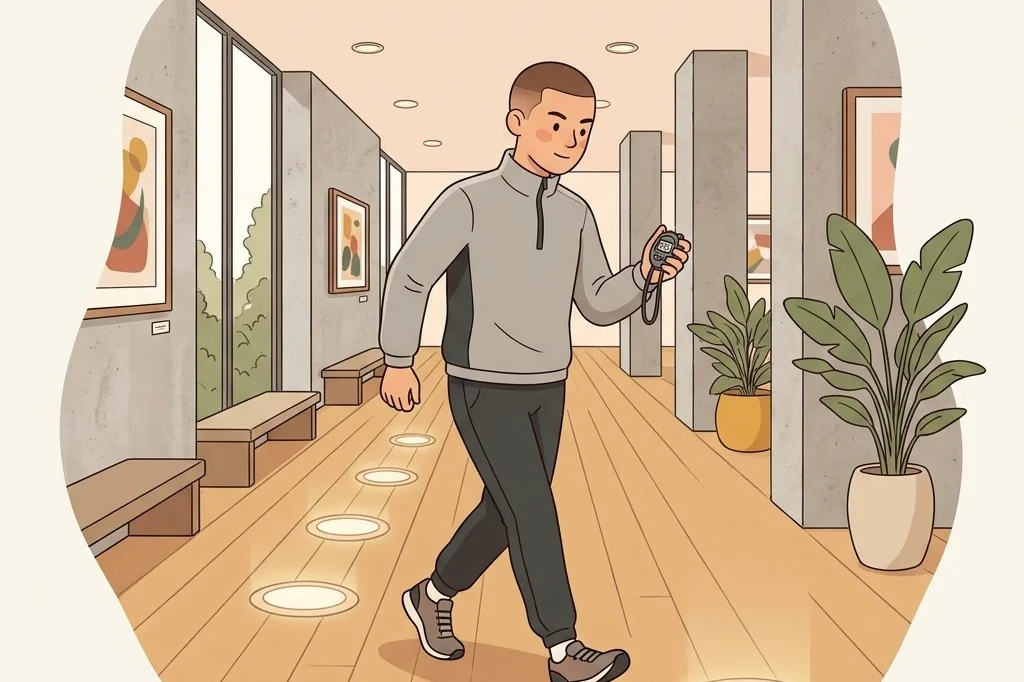
Run these three structured conditioning drills with a stopwatch:
1. The 15-Second Blitz
Set a timer for 15 seconds. Traverse an entire 20-station palace from start to finish. Do not analyze the underlying concepts; simply verify that each visual interaction triggers in rapid succession like frames of a high-speed motion picture film. If your avatar snags on a station, mark that locus for visual simplification.
2. The Odd-Even Alternating Leap
Start at Station 1 and leap directly to Station 3, then Station 5, Station 7, and so forth, completely skipping the even stations. Once you reach the end, reverse the drill and traverse the even stations backward: Station 20, Station 18, Station 16, down to Station 2. This drill dismantles linear dependency habits and forces your mind to see stations as independent spatial coordinates.
3. The Flashcard Coordinate Prompt
Create a small digital or physical deck of cards containing only numbers: 4, 17, 9, 2, 14. Shuffle the deck, flip a card, and give yourself exactly 1.5 seconds to name the specific object, motion, and concept anchored at that coordinate. This rapid flash drill builds true non-linear fluency.
Streamlining Mental Rendering Overhead
A major cause of retrieval lag is unnecessary visual rendering. Novices often believe they must mentally render every wood grain on the floor, the texture of the curtains, and the reflections in the windows before examining their mnemonic actor. This excessive rendering burns massive working-memory bandwidth.
Adopt a “low-resolution background, high-definition actor” rendering strategy:
- The Backdrop Stays Stylized: Allow the surrounding room to remain a soft, ambient outline. You only need to know that you are standing in your living room; you do not need to calculate ray-traced shadows on the ceiling.
- The Focal Interaction Stays Sharp: Focus 90 percent of your mental resolution directly on the point of physical contact where the mnemonic prop impacts the furniture locus.
- Extract Meaning, Not Pixels: The moment your brain registers what the symbol represents, move forward immediately. You do not need to linger and admire the mental artwork.
By stripping away unnecessary decorative rendering, you free up cognitive resources, accelerating your execution within any rapid skill acquisition framework.
Stress Inoculation and Real-Time Retrieval
Practicing in a silent, comfortable bedroom produces artificial confidence. When you step into a live meeting, an exam hall, or an impromptu pitch, heightened stress and cortisol surges narrow your attentional focus and impair working memory access. If your palace skills have only been tested in isolation, your retrieval speed will plummet.
Conduct stress-inoculation drills during your weekly practice sessions:
- Auditory Interference: Put on headphones playing ambient coffee shop noise, podcasts, or television news while traversing your palace and reciting data points out loud.
- Physical Dual-Tasking: Walk briskly on a treadmill, bounce a tennis ball against a wall, or pace around your office while retrieving complex data points. Coupling motor coordination with spatial retrieval builds robust cognitive fault tolerance.
- High-Stakes Timer Pressure: Give yourself a strict 45-second limit to extract eight interrelated points required to answer a hypothetical case study question.
Frequently Asked Questions
How fast should I realistically be able to retrieve a data point?
With structured random-access practice, retrieving an anchored data point from any coordinate should take between 1.0 and 2.5 seconds. At this speed, retrieval integrates smoothly into normal conversational pauses without drawing unwanted attention.
Does speed retrieval increase the risk of making mistakes?
Only if you skip conditioning drills. When you practice high-velocity sprints during training, you identify weak stations and reinforce them. In real-world execution, your brain operates comfortably below its maximum sprint capacity, ensuring high accuracy.
Why do I sometimes freeze at a specific locus during a speed run?
Freezing indicates a “low-contrast anchor.” The visual image either lacks kinetic motion or looks too similar to adjacent stations. Revisit that station, strip the old imagery, and install a dramatic, contrasting physical action to eliminate hesitation.
Should I practice speed retrieval every day?
Five minutes of targeted speed drills three times a week is sufficient to maintain rapid fluency across multiple palaces. Short, intense bursts yield far better neuroplastic adaptations than marathon weekend cramming sessions.
Speed is the bridge that turns mnemonic architecture from a cumbersome study trick into an instantaneous superpower. Install clear milestone waypoints, strip away decorative mental rendering, and run regular sprint drills until your mental vaults open on command.